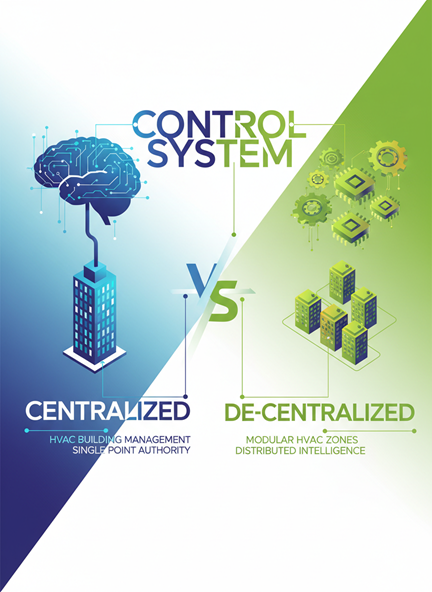
Centralize VS De-Centralize Control System
Optimal Comfort, Efficiency & Reliability
Smart Control: Coordinated Strategy + Responsive Execution
In modern building management, the heating, ventilation, and air conditioning (HVAC) system is paramount. It dictates comfort, indoor air quality, energy efficiency, and occupant well-being.
The backbone of sophisticated HVAC control lies in the Building Management System (BMS), often referred to as a Building Automation System (BAS).
How this BMS manages its control – through centralization or decentralization – fundamentally shapes the system's performance, reliability, and flexibility.
A centralized control system for HVAC relies on a single, powerful controller acting as the brain.
This master controller receives inputs from sensors across various zones or equipment components (like temperature probes in different rooms), processes this information according to pre-defined algorithms and schedules, and then sends output commands to multiple subordinate devices.
Think of it like controlling an entire orchestra—one maestro dictates tempo and volume for all musicians.
Advantages of Centralized Control:
- Simplicity: A centralized approach is often simpler in its overall structure from a high-level view. There's a clear hierarchy, with the central controller being responsible for most decisions.
- Uniformity: Easier to ensure consistent control strategies across different zones or systems because they are all governed by the same primary logic residing in the central unit.
- Remote Monitoring and Control: A major strength is the ability for operators (from a BMS console, typically located elsewhere like an operations room) to monitor multiple aspects of the building's HVAC performance simultaneously and control equipment remotely with relative ease.
A decentralized control system empowers individual HVAC equipment units.
Such as individual air handling units (AHUs), variable air volume (VAV) boxes, chillers, boilers, and even zones within a single unit—with their own local intelligence.
Each piece of equipment has an embedded controller that can monitor its internal conditions (temperature, pressure, humidity), control itself directly (adjusting dampers, fans, valves), and communicate necessary information or status updates back to the BMS.
Advantages of Decentralized Control:
- Redundancy & Reliability: Each local device is independent for basic self-monitoring and control. Even if a part of the central server system (the "head office") experiences issues, individual HVAC zones or equipment can often continue functioning using their own logic, significantly improving overall resilience.
- Reduced Central Load: The communication burden on the BMS central server is reduced because devices primarily report status ("I am here" – temperature reading) rather than constantly seeking instructions for every minor fluctuation. This makes it easier to manage large-scale systems without overwhelming network resources.
- Faster Local Response: Equipment can react almost instantaneously to local changes (e.g., a sudden room occupancy or a window opening) by adjusting its own parameters directly, leading to faster correction of deviations and potentially greater comfort in dynamic environments.
- Modularity & Scalability: Adding new zones or equipment is often easier, as it primarily involves integrating into the central database structure rather than reprogramming every single point.
- Reduced Wiring Complexity: Especially for zone control (e.g., managing temperature separately per room), decentralized systems significantly reduce the complexity and cost of wiring compared to traditional centralized wiring, aligning with modern network-based approaches.
Conclusion
The choice between centralized and decentralized (or distributed) HVAC/BMS control systems is not merely an academic exercise; it directly impacts operational efficiency, system reliability, responsiveness to changing conditions, and implementation cost. Centralized BMS offers powerful remote oversight but creates single points of failure and communication bottlenecks if over-relied upon.
Decentralized BMS enhances resilience through local autonomy, improves response times for variable loads, reduces central communication load, and aligns with the trend towards more connected devices (IoT). However, it comes with higher initial complexity.
The optimal solution often lies in a sophisticated hybrid approach. A robust central server provides strategic control and coordination while empowering individual HVAC equipment to handle their own dynamic adjustments efficiently. This synergy allows for complex, energy-aware building management strategies delivered reliably through local intelligence and coordinated via the networked BMS platform. Understanding these fundamental differences helps stakeholders choose the right control paradigm or structure that best suits a specific project's requirements, complexity level, budget constraints, and priorities regarding robustness versus simplicity in modern HVAC systems.